
Advisory: City and County of Denver Pipe Jack Flashings Inspection Compliance
The CRA Building Code & Standards Committee has communicated with and confirmed the following requirement with the City and County of Denver, and they have asked us to help spread the word.
If your crews are painting the neoprene or EPDM portion of pipe jack flashings, this must stop and be addressed immediately.
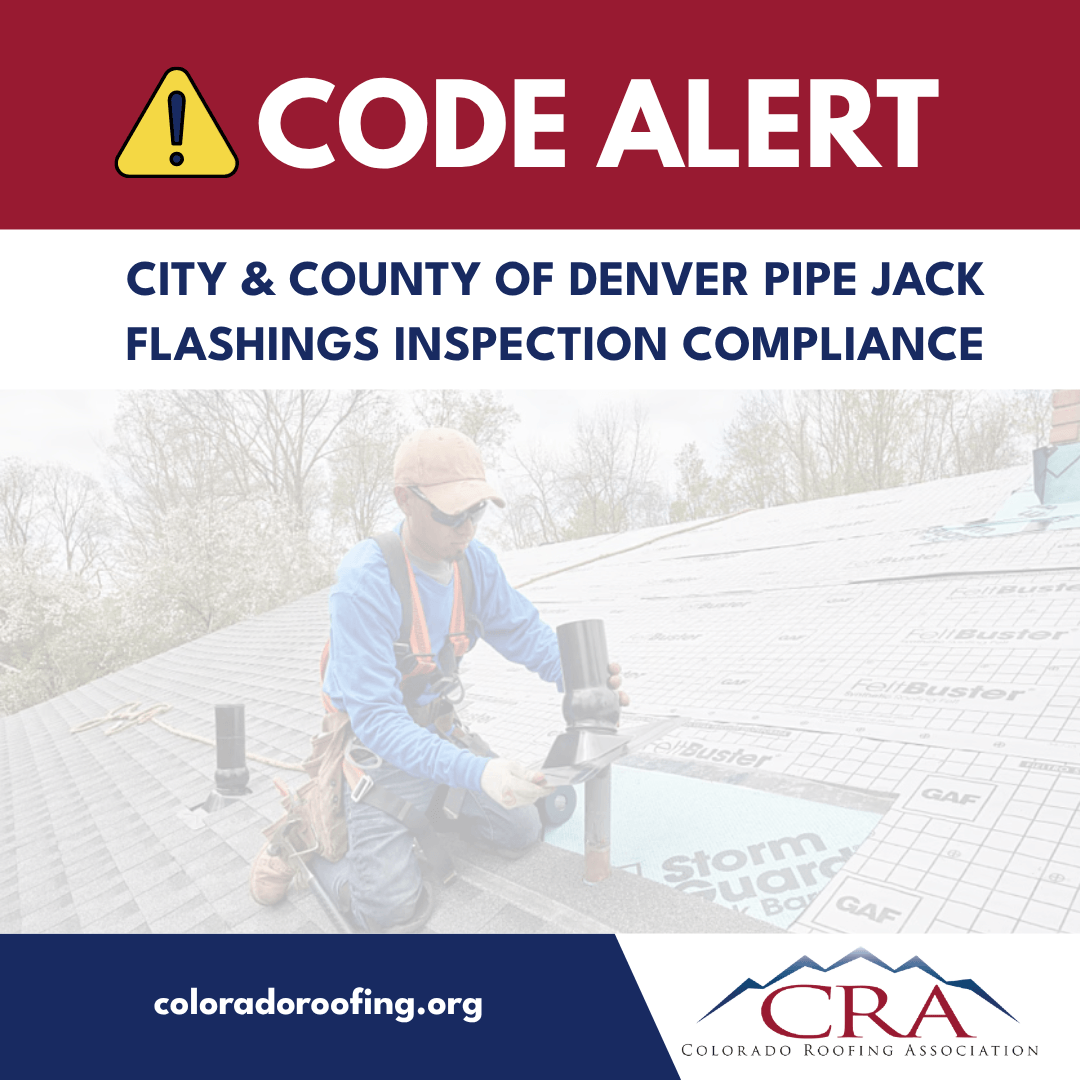
Painted pipe jack boots are being identified during inspections as improper installations within the City and County of Denver. These conditions are resulting in failed inspections, required corrective work, and additional labor costs.
Although this requirement may not be explicitly stated in local code language or published on the City of Denver’s website, compliance is enforced through manufacturer installation instructions. These instructions are considered part of the adopted building code and do not require separate policy adoption. This applies broadly to all construction materials and systems, which is why many jurisdictions require installation instructions to be submitted with permit documents or maintained on-site during inspection.
Manufacturer guidance clearly states that elastomeric collars must not be painted. Paint products—including acrylic and synthetic latex—often contain petroleum-based components that can accelerate the degradation of neoprene and EPDM materials.
For example, IPS Roofing Products specifies:
“Do not use petroleum-based mastics, sealing compounds, or paints on the collar portion of all flashings, including hard-base, flexible, or rain collars. Do not use paint on elastomer collars,” due to the risk of premature failure.
Required Actions (Effective Immediately):
-
Review manufacturer installation instructions
-
Communicate this requirement to crews and painters
-
Update standard operating procedures
Prevention:
-
Use pre-painted pipe-jacks
-
Cover pipe jack boots before spraying
-
Provide crews with temporary or extra boots to place over and protect new installations
-
Remove protective coverings after coatings are complete
Failure to address this issue will continue to result in inspection failures and avoidable callbacks. Taking proactive steps now will protect your crews, your schedule, and your bottom line.