
Class 3 vs Class 4 Shingles: Which is Best For Colorado Homes?
When a contractor or insurance adjuster brings up class 3 vs. class 4 shingles, most Colorado homeowners are hearing those terms for the first time. The distinction matters more in Colorado than almost anywhere else in the country, because the hail that hits this state is exactly what those ratings are designed to measure against.
In Colorado, where hailstorms are a regular part of life, the class 3 vs. class 4 shingles question comes up on nearly every roof project. This guide explains what the ratings mean, how the two compare on durability, cost, and insurance savings, and what to consider before choosing.
In This Article
- What Do Class 3 and Class 4 Shingle Ratings Mean?
- How Do Class 3 vs. Class 4 Shingles Compare?
- What Is the Price Difference Between Class 3 and Class 4 Shingles?
- Are Class 4 Shingles Worth the Extra Cost in Colorado?
- What Are the Drawbacks of Class 4 Shingles?
- Should You Choose Class 3 or Class 4 Shingles in Colorado?
- Working with a Colorado Roofing Contractor
- Frequently Asked Questions
What Do Class 3 and Class 4 Shingle Ratings Mean?
Class 3 and class 4 shingles differ in impact resistance, with class 4 being the highest rating available under the UL 2218 standard and better suited for Colorado's hail exposure.
The test, known as the steel ball test, assigns one of four ratings to a shingle, with class 4 being the highest possible rating. The testing involves dropping steel balls of different diameters from varying heights onto the shingles to simulate hail. A higher class indicates better impact resistance.
A class 3 shingle must remain uncracked when struck twice in the same area by a steel ball with a diameter of 1.75 inches. A class 4 shingle must show no damage when hit twice in the same spot by a steel ball measuring 2 inches in diameter. Colorado regularly sees hailstones in that size range.
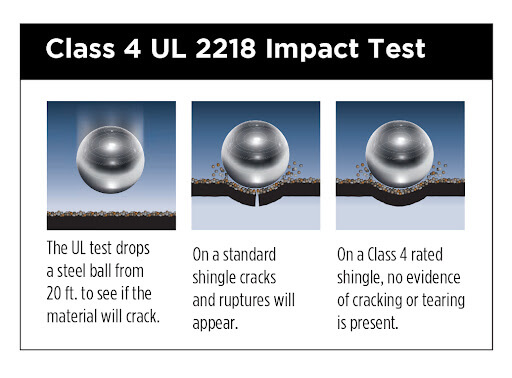
(Image source: CertainTeed)
How Do Class 3 vs. Class 4 Shingles Compare?
Here is what Colorado homeowners need to know about the durability, hailstorm resilience, and insurance benefits of class 3 and class 4 shingles.
Durability
Class 4 shingles are generally marketed with longer expected lifespans than class 3, though actual longevity depends heavily on installation quality, attic ventilation, and climate exposure.
- Class 4 shingles are engineered for severe weather. Manufacturers achieve the rating by reinforcing the shingle with polymer-modified asphalt or other reinforcement technologies, which allows the shingle to absorb impact rather than crack. They offer top-tier impact resistance, are often marketed with expected lifespans of 30 years or more, and many class 4 products also carry wind ratings up to 130 mph, making them a stronger choice in Colorado's combined hail and wind environment.
- Class 3 shingles are durable and reliable, often marketed with expected lifespans of 20 to 25 years under normal conditions. They may be better suited for areas with lower hail frequency or smaller average hailstone size.
A class 3 or class 4 shingle is only as good as the installation behind it. Work with a licensed Colorado roofing contractor to ensure you get the protection you paid for.
Hailstorm Resilience
Class 4 shingles hold up better against Colorado hail because they are engineered to absorb impact rather than crack, making them the stronger choice in a state that averages 94 hail events per year and ranks second in the country for per-capita hail damage, with roughly $151 million in statewide property losses annually.
Colorado sits in the heart of Hail Alley and faces some of the most frequent and intense hailstorms in North America. The May 2017 Front Range hailstorm alone generated $2.3 billion in insured losses from approximately 100,600 homeowners claims, per the Rocky Mountain Insurance Information Association.
- Class 4 shingles carry the highest impact resistance rating and are designed to absorb and dissipate the force of hail impacts, reducing the risk of damage.
- Class 3 shingles offer a solid level of protection against hail, though their resilience is lower than class 4, particularly during storms with larger hailstones.
After a storm, a professional inspection by a trusted roofing contractor can help document any damage and confirm whether your shingles are still intact.
Insurance Benefits
Class 4 shingles may also qualify for insurance discounts, which is a significant consideration for Colorado homeowners.
- Insurance savings. Many Colorado insurers offer premium discounts for homes with class 4 shingles installed, often ranging from about 5% to 25%, though higher credits may be available depending on the carrier and policy. The discount varies by carrier, and not every class 4 product qualifies with every insurer. Confirm the specific credit with your insurance company and ask whether the shingle you are considering appears on their approved list.
- Local code requirements. Some Colorado jurisdictions, including Larimer County and Fort Collins, have adopted building code requirements that favor or require class 4 impact-resistant roofing in many situations. Requirements can vary based on roof type, slope, and project scope. Check with your local building department or ask your contractor to confirm what applies to your specific project before selecting a product.
For more information on how to navigate roofing insurance and ensure your roof replacement is handled efficiently, see Navigating Roofing Insurance for Roof Replacement.
What Is the Price Difference Between Class 3 and Class 4 Shingles?
Class 4 shingles typically cost more than class 3, often in the range of about $1 to $1.50 per square foot, depending on product and market conditions, which translates to roughly $2,000 to $3,000 in additional material costs on an average 2,000-square-foot Colorado home. To put that in context, a full residential roof replacement in Colorado runs between $9,500 and $24,000, depending on home size and materials, meaning the class 4 upgrade typically represents about 10% to 20% of the total project cost.
"Class 4 shingles seem to be about $50.00 more per square than the Class 3 options, based on Xactimate pricing," says Scott Ponzio, owner of RTP Roofing Co. Labor costs are comparable for both products in most installations.
Are Class 4 Shingles Worth the Extra Cost in Colorado?
Class 4 shingles are worth considering for most Colorado Front Range homeowners because the available insurance discounts can offset the material cost over time, though the payback timeline depends on your specific carrier and premium.
Colorado premiums are already among the highest in the country because of hail risk. In some cases, the discount on the wind and hail portion of a policy can translate to several hundred dollars per year in savings, depending on your premium and coverage. At a material upgrade cost of $2,000 to $3,000, homeowners who qualify for meaningful discounts often see the investment pay for itself within a few years.
Many Colorado homeowners choose to upgrade to class 4 shingles during an insurance claim, even when the original roof was class 3. The insurance settlement typically covers the cost to replace in kind, and the homeowner pays the difference to upgrade. A licensed contractor can walk you through filing a claim after storm damage and help document the installation for your insurer.
For homeowners doing a planned replacement on an aging roof rather than filing a claim, the math still holds up in most Front Range zip codes. The class 4 upgrade adds a fixed cost at the time of replacement, and the annual insurance savings begin immediately once the new roof is documented with your carrier. Over the life of the roof, the cumulative discount can exceed the upgrade cost for homeowners paying Front Range insurance rates and qualifying for carrier discounts.
What Are the Drawbacks of Class 4 Shingles?
The main drawbacks of class 4 shingles are a higher upfront material cost, a somewhat more limited selection of styles and colors, and lower financial return in areas of Colorado where large-diameter hail is less frequent.
The upfront cost is higher. When a roof replacement is not insurance-driven and you are paying out of pocket, the $2,000 to $3,000 material premium is real. For homeowners who do not qualify for a meaningful insurance discount, the payback period can extend well beyond what the insurance savings would justify.
The style selection may be somewhat more limited. Class 4 product lines have grown considerably in recent years. They may still offer fewer choices in colors and profiles than standard architectural shingle lines depending on the manufacturer. If a specific look matters to you, check what is available in class 4 before committing.
Not every location carries the same risk. On the Western Slope, where large-diameter hail is less frequent than on the Front Range, the financial case for class 4 shingles is weaker. For some homeowners in lower-risk areas, class 3 provides solid protection at a lower cost. A licensed contractor familiar with your county and your insurer can help you assess whether the upgrade makes sense for your situation.
Should You Choose Class 3 or Class 4 Shingles in Colorado?
Whether you should get class 3 or class 4 shingles depends on where your home is located in Colorado, what your insurer offers, and whether local building code has already required class 4 for your jurisdiction.
Where is your home located? If your home is on the Front Range or along the I-25 corridor, class 4 shingles are generally the more practical long-term investment. If your home is on the Western Slope or in a lower-hail-risk county, class 3 shingles are a reasonable and cost-effective option.
Has local code already made the decision? Some Colorado jurisdictions have adopted requirements that favor or require class 4 shingles in many situations, including Larimer County and the City of Fort Collins. Requirements can vary based on roof type, slope, and project scope. Check with your local building department or ask your contractor to confirm what applies to your specific project before selecting a product.
What does your insurer offer? Call your insurer and ask three questions. Does your policy include a discount for class 4 shingles? Which products qualify? Does the discount apply to your full premium or just the wind and hail portion? Those answers will tell you whether the upgrade math works for your home.
Once you have those answers, a licensed CRA member contractor can help you compare specific products, verify local code requirements, and put together a clear cost picture for your roof. Find a contractor in your area here.
Working with a Colorado Roofing Contractor on Class 3 vs. Class 4 Shingles
The class 3 vs. class 4 shingles choice is only part of the equation. The contractor you hire matters as much as the product. Poor installation can void a manufacturer's warranty, and after a storm, working with a vetted local contractor rather than a door-to-door storm chaser protects both your roof and your insurance claim.
The Colorado Roofing Association maintains a directory of licensed, insured roofing contractors across the state. Find a CRA member contractor in your area to get a professional assessment and a clear comparison of your class 3 and class 4 options.
Frequently Asked Questions About Class 3 vs. Class 4 Shingles
What is the difference between class 3 and class 4 shingles?
Class 3 and class 4 shingles are both rated under the UL 2218 impact resistance standard. Class 3 shingles are tested against a 1.75-inch steel ball, and class 4 shingles are tested against a 2-inch steel ball, both dropped from set heights. Class 4 is the highest rating available and is better suited for hail-prone areas like Colorado's Front Range.
Are class 4 shingles required in Colorado?
Some Colorado jurisdictions have adopted requirements that favor or require class 4 shingles in many situations, including Larimer County and the City of Fort Collins. Requirements can vary based on roof type, slope, and project scope and are not always blanket requirements with no exceptions. Check with your local building department or ask your contractor to confirm what applies to your specific project before selecting a product.
How much more do class 4 shingles cost compared to class 3?
Class 4 shingles typically add about $1 to $1.50 per square foot compared to standard asphalt products, depending on product and market conditions, which translates to roughly $2,000 to $3,000 in additional material costs for a 2,000-square-foot Colorado home. Labor costs are comparable for both products.
What insurance discount do class 4 shingles qualify for in Colorado?
Many Colorado insurers offer premium discounts for homes with class 4 shingles, often ranging from about 5% to 25%, though higher credits may be available depending on the carrier and policy. Not all class 4 products appear on every insurer's approved list. Confirm the discount with your insurance company before purchasing and provide documentation of the installed product's UL 2218 rating to claim it.
Does class 4 mean my roof is hail-proof?
Class 4 is the highest impact resistance rating available, but it does not mean a roof cannot be damaged by hail. It means the shingle survived a standardized lab test using a 2-inch steel ball. Severe Colorado hailstorms, particularly those producing stones larger than 2 inches, can still cause cosmetic or structural damage to a class 4 roof. The rating reduces the risk and severity of damage compared to standard shingles and lowers the likelihood of a full roof replacement after a storm, but no shingle is completely hail-proof.
Do class 4 shingles look different from regular shingles?
Class 4 shingles look the same as standard architectural shingles from the street. The reinforcement that earns the class 4 rating, whether polymer-modified asphalt or other reinforcement technologies, is not visible once the roof is installed. Most major manufacturers offer class 4 versions of their most popular product lines, so homeowners rarely have to sacrifice the look they want to get the protection they need.
How do I know if my current roof is class 3 or class 4?
The easiest way to find out is to check your original installation paperwork or the manufacturer's product name, then look it up on the manufacturer's website. If you do not have those records, a licensed contractor can identify the product during an inspection. Your insurance company may also have the shingle class on file if your policy includes a premium credit for impact-resistant roofing.
What are some common class 4 shingle products available in Colorado?
Several major manufacturers offer class 4 shingles widely available through Colorado roofing contractors. GAF's Timberline ArmorShield II and Owens Corning's Duration Storm are two of the most common options on the Front Range. CertainTeed's NorthGate is another frequently specified product. Your contractor can tell you which products appear on your specific insurer's approved credit list, since not all class 4 shingles qualify for discounts with every carrier.
How do I prove to my insurance company that I have class 4 shingles?
Your roofing contractor should provide a certificate of completion or manufacturer's product documentation confirming the UL 2218 class 4 rating of the installed shingles. Keep a copy of the installation invoice, the product name, and the manufacturer's warranty documentation. Some insurers also require a photo of the shingle packaging or the product label from the job site. Submit this documentation to your insurer after installation to activate the premium discount. If you are unsure what your carrier requires, ask your contractor before the project starts, since gathering documentation after the fact can delay your savings.
Can I upgrade to class 4 shingles during an insurance claim?
Yes. Many Colorado homeowners choose to upgrade from class 3 to class 4 shingles during a claim. The insurance settlement typically covers the cost to replace in kind, and the homeowner pays the difference to upgrade. A licensed contractor can help document the installation for your insurer and walk you through filing a claim after storm damage.
Should I get class 3 or class 4 shingles?
The right answer depends on where you live in Colorado, what your insurer offers, and whether local code has already decided for you. Homeowners on the Front Range generally benefit from class 4 shingles given the potential insurance savings and hail exposure. Homeowners in lower-risk areas may find class 3 shingles are the more practical choice. A licensed CRA member contractor can help you weigh the options for your specific situation.